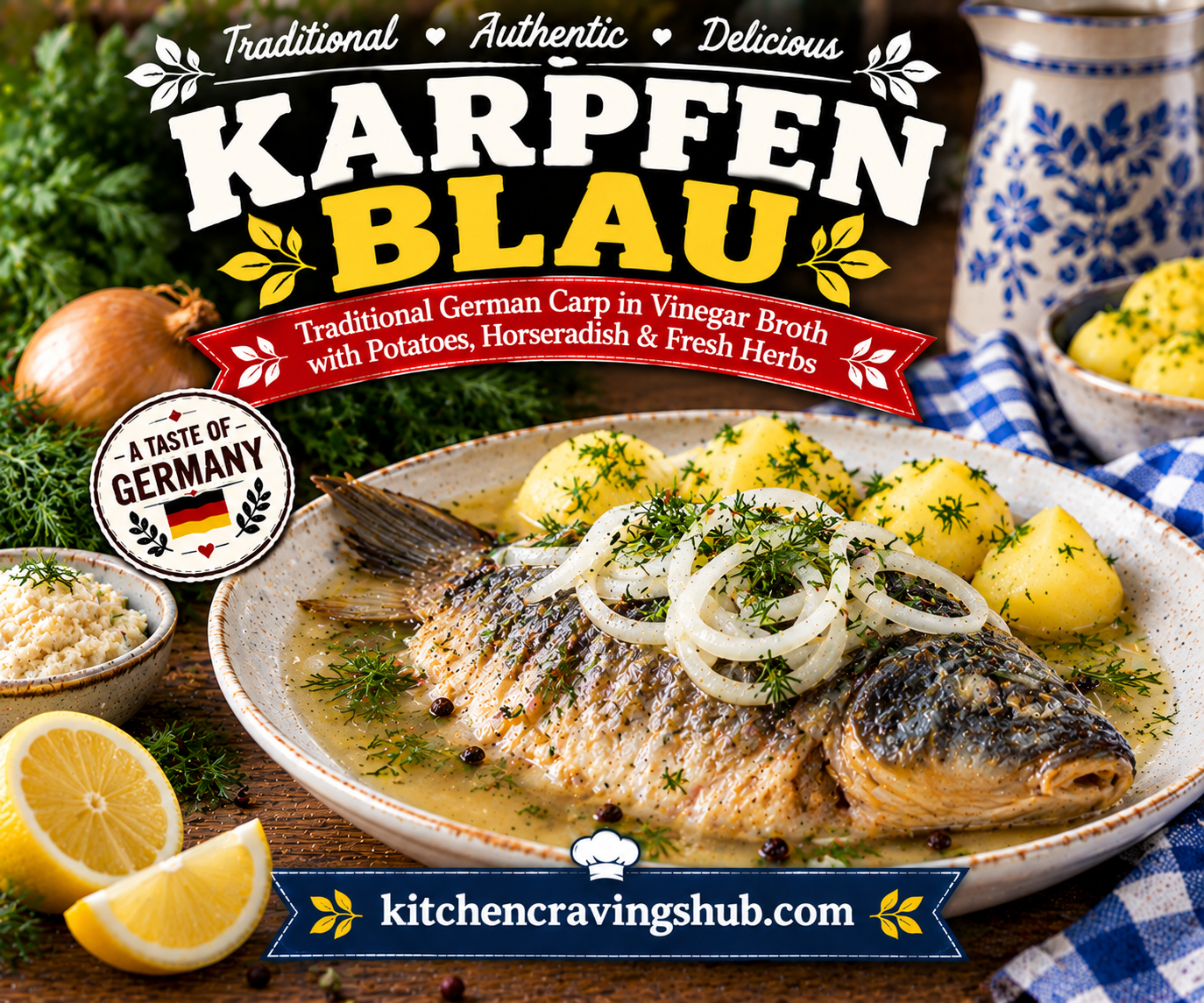
When it comes to iconic German holiday dishes, few carry as much tradition and history as Karpfen Blau. Literally translating to “blue carp,” this dish has graced German dinner tables for centuries, especially during Christmas Eve celebrations. With its uniquely poached preparation that gives the fish skin a striking blue tint, Karpfen Blau is as visually memorable as it is deeply rooted in German culinary heritage.
In this article, we are going to explore everything you need to know about Karpfen Blau. What it actually is, why the fish turns blue, how to prepare it at home, and why this traditional dish continues to hold such a special place in German food culture. Let us dive in! 🎄
🍽️ What Exactly Is Karpfen Blau?
Karpfen Blau is a traditional German dish made by poaching a whole carp in a seasoned vinegar based broth, known as a court bouillon, which typically includes vinegar, root vegetables, bay leaves, peppercorns, and other aromatics. The vinegar in the poaching liquid reacts with the natural mucus coating on the fish’s skin, causing it to turn a striking blue gray color during cooking, which is exactly where the dish gets its name.
The fish is traditionally served whole, gently poached rather than fried or baked, and accompanied by simple sides like boiled potatoes, melted butter, and horseradish. The preparation method preserves the delicate, tender texture of the carp while allowing the mild, earthy flavor of the fish to shine through.
You will often find Karpfen Blau:
- 🎄 On Christmas Eve dinner tables across Germany, Austria, and parts of Central Europe
- 🍽️ At traditional German restaurants during the winter holiday season
- 🎣 In regions with strong carp farming traditions, such as Bavaria and Saxony
- 🕍 As part of broader European Christmas Eve fish traditions
📜 The History and Tradition Behind Karpfen Blau
Carp has been farmed and consumed across Central Europe for centuries, with monasteries historically playing a significant role in cultivating carp ponds, particularly because fish was considered an acceptable food during religious fasting periods, including the traditional meatless Christmas Eve meal observed in many Christian households.
Over time, carp became closely associated with Christmas Eve dinners throughout Germany, Austria, Poland, and parts of the Czech Republic, each region developing its own preferred preparation style. While some countries favor fried carp, particularly in Poland and parts of Bavaria, the Karpfen Blau method remains especially popular in Saxony and other regions with strong culinary ties to traditional poaching techniques.
The distinctive blue color that gives the dish its name became something of a source of pride among cooks, as achieving that vibrant blue tint was historically seen as a sign of a perfectly fresh fish and a properly executed poaching technique. 🕰️
🧡 Why People Still Love Karpfen Blau
There are several reasons this traditional dish has remained a cherished part of German holiday celebrations for centuries.
- 🎄 It carries deep cultural and religious significance tied to Christmas Eve traditions
- 🐟 The poaching method results in a tender, delicate texture
- 🥔 It pairs beautifully with simple, comforting sides like potatoes and butter
- 👵 It is a treasured family recipe passed down through generations
- 🌿 The preparation highlights the natural, mild flavor of the fish without heavy seasoning
Whether you grew up with this dish as part of your family’s holiday traditions or are curious to try it for the very first time, Karpfen Blau offers a wonderful glimpse into centuries old German culinary heritage.
🛒 Ingredients You Will Need
Preparing Karpfen Blau requires a few specific ingredients, most notably a whole fresh carp and a well balanced poaching liquid.
🍽️ Core Ingredients Table
| Ingredient | Quantity | Notes |
|---|---|---|
| 🐟 Whole fresh carp | 1, approximately 1.5 to 2 kilograms | Freshness is essential for the best flavor and color |
| 🍶 White vinegar | 250 milliliters | Essential for achieving the signature blue color |
| 💧 Water | 1.5 liters | Forms the base of the poaching liquid |
| 🥕 Carrots | 2 medium | Roughly chopped |
| 🧅 Onion | 1 large | Peeled and quartered |
| 🌿 Bay leaves | 2 to 3 | Adds aromatic depth |
| ⚫ Whole peppercorns | 1 teaspoon | For gentle spice |
| 🧂 Salt | To taste | Balances the acidity of the broth |
| 🌿 Fresh parsley stems | A small handful | Adds herbal freshness |
| 🥔 Boiled potatoes | For serving | Traditional accompaniment |
| 🧈 Melted butter | For serving | Drizzled over the finished fish |
| 🌱 Horseradish | For serving | Adds a sharp, traditional kick |
👩🍳 How to Make Karpfen Blau at Home
This dish requires a bit more care than some simpler recipes, but the process is very manageable with a little patience. Here is a step by step guide.
Step by Step Instructions
- 🐟 Start with a very fresh, whole carp, ideally cleaned and gutted by your fishmonger while keeping the skin fully intact, as this is essential for achieving the blue color
- 🧼 Rinse the fish gently under cold water, being careful not to disturb or remove the natural slime coating on the skin
- 🍶 In a large pot, combine the water, vinegar, carrots, onion, bay leaves, peppercorns, salt, and parsley stems
- 🔥 Bring the poaching liquid to a gentle boil, then reduce to a simmer for about 15 minutes to allow the flavors to develop
- 🐟 Carefully lower the whole carp into the simmering liquid, making sure it is fully submerged
- ⏳ Poach gently for 20 to 25 minutes, depending on the size of the fish, until the flesh is opaque and cooked through
- 🔵 As the fish cooks, you should notice the skin developing its signature blue gray tint from the reaction with the vinegar
- 🍽️ Carefully remove the fish from the poaching liquid using a large slotted spatula or fish lifter, keeping it as intact as possible
- 🥔 Serve immediately alongside boiled potatoes, melted butter, and freshly grated horseradish
And there you have it, a beautifully traditional Karpfen Blau ready to be enjoyed as the centerpiece of a festive holiday meal.
🎨 Popular Variations and Regional Differences
While the classic poached preparation remains the most iconic version, different regions and households have their own take on serving carp during the holidays.
🍴 Variation Comparison Table
| Variation Name | Key Difference | Flavor Profile |
|---|---|---|
| 🔵 Classic Karpfen Blau | Whole fish gently poached in vinegar broth | Mild, delicate, and tender |
| 🍞 Fried Carp | Breaded and pan fried fillets | Crispy and hearty |
| 🌿 Herb Poached Carp | Additional fresh herbs like dill and thyme added | Bright and aromatic |
| 🍋 Lemon Poached Carp | Lemon slices added to the poaching liquid | Slightly tangy and fresh |
| 🧄 Garlic Infused Carp | Garlic cloves added to the broth | Warm and savory |
Depending on your family traditions or regional preferences, feel free to adjust the aromatics in your poaching liquid to suit your personal taste.
🥤 What to Pair With Karpfen Blau
Since this dish is delicate and mild in flavor, it pairs beautifully with light, crisp beverages that do not overwhelm the fish.
- 🍷 A dry white wine, such as Riesling, which pairs wonderfully with delicate fish dishes
- 🍺 A light German pilsner for a more casual pairing
- 🥤 Sparkling water with a slice of lemon
- ☕ A warm herbal tea to round out a cozy holiday meal
🌍 Where Karpfen Blau Fits Into German Food Culture
Karpfen Blau holds a deeply meaningful place within German holiday traditions, particularly around Christmas Eve. It is often associated with:
- 🎄 Traditional Christmas Eve dinners, especially in regions with strong Catholic and Protestant fasting traditions
- 🏰 Historical monastery carp farming traditions dating back centuries
- 👵 Recipes carefully passed down through generations of German families
- 🍽️ Formal, celebratory holiday meals shared with loved ones
For many German families, preparing Karpfen Blau is not just about the meal itself, but about honoring a tradition that connects them to generations of holiday celebrations before them.
💡 Tips for the Best Karpfen Blau
To make sure your Karpfen Blau turns out beautifully, keep these helpful tips in mind.
- 🐟 Always start with the freshest possible fish, ideally purchased the same day it will be prepared
- 🧼 Avoid scaling or heavily washing the fish, since the natural slime coating is essential for achieving the blue color
- 🍶 Do not skip the vinegar, as it plays the key role in creating the dish’s signature appearance
- ⏳ Monitor the poaching time closely to avoid overcooking, which can make the flesh tough
- 🥔 Serve immediately after cooking for the best texture and presentation
❓ Frequently Asked Questions
Why does the carp turn blue when poached? The blue color comes from a chemical reaction between the vinegar in the poaching liquid and the natural slime coating on the fish’s skin.
Is Karpfen Blau difficult to prepare at home? While it requires a bit more care than simpler recipes, the process is very manageable for home cooks with some patience and a fresh, whole fish.
What is traditionally served alongside Karpfen Blau? Boiled potatoes, melted butter, and freshly grated horseradish are the most traditional accompaniments.
Can I use a different type of fish? While carp is traditional and essential for the classic blue color effect, other mild, firm fleshed fish can technically be poached using a similar method, though the color and flavor will differ.
🍽️ Final Thoughts
Karpfen Blau is far more than just a holiday dish, it is a beautiful reflection of centuries old German culinary tradition, religious history, and family heritage. From its striking blue tinted skin to its delicate, tender flavor, this dish offers a truly unique dining experience that connects modern families to generations of holiday celebrations before them.
Whether you are hoping to honor a cherished family tradition or simply curious to try a truly unique piece of German culinary history, Karpfen Blau is well worth the effort. Gathered around the table with loved ones, this dish becomes so much more than a meal, it becomes a meaningful holiday tradition. 🧡🐟🎄
Have you ever tried Karpfen Blau before? I would love to hear about your family traditions or holiday memories surrounding this iconic German dish in the comments below!