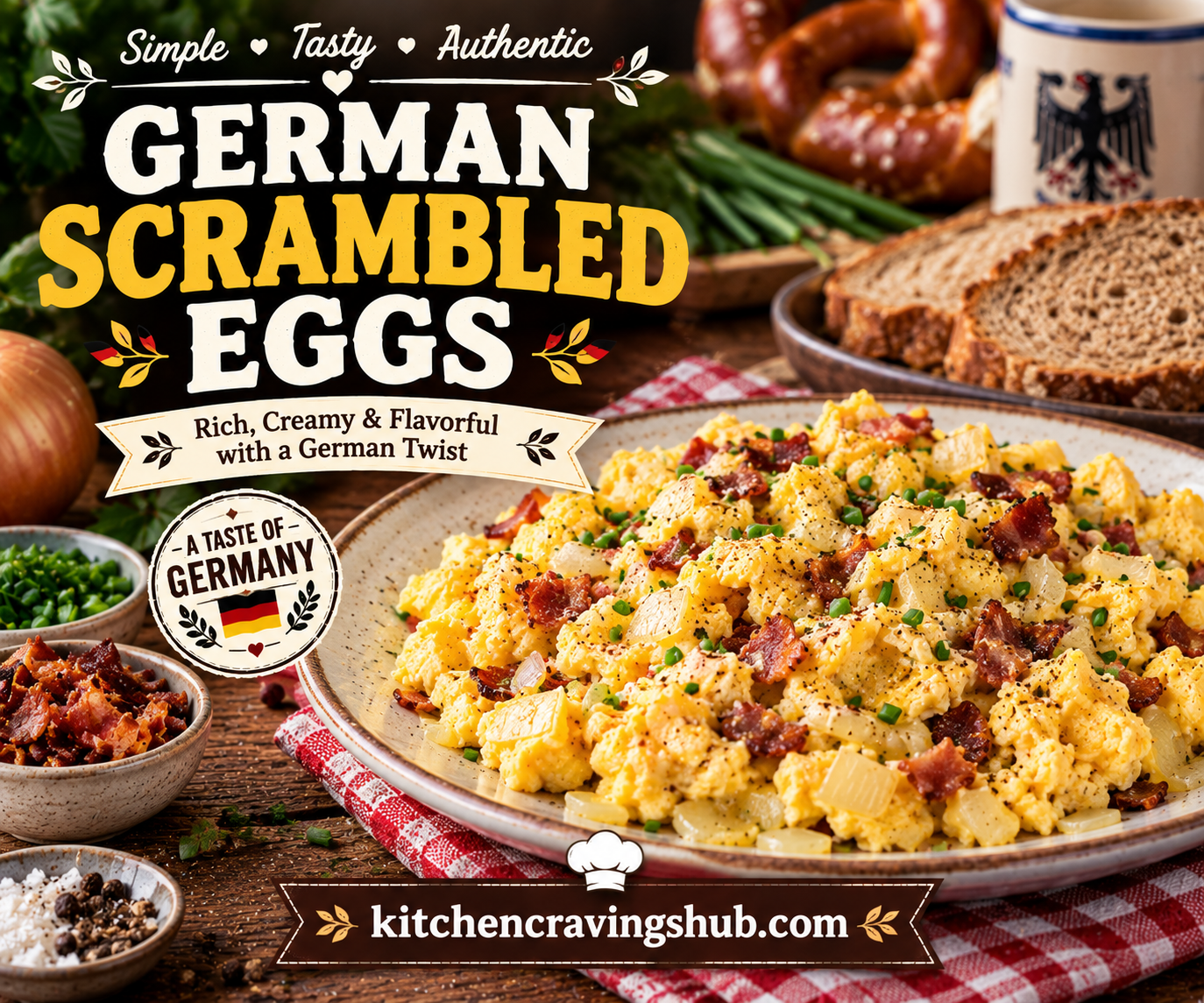
While scrambled eggs might seem like one of the simplest dishes in any kitchen, German cooking brings its own distinct approach to this humble breakfast staple. Known as “Rühreier,” German scrambled eggs are typically prepared slower and with a gentler hand than many other styles, resulting in soft, creamy curds rather than dry, rubbery bits. Often served alongside hearty additions like potatoes, bacon, or fresh herbs, this dish is a beloved part of German breakfast culture. This guide covers the history and technique behind German scrambled eggs, a full step by step recipe, popular variations like the classic farmer’s breakfast, and everything else you need to bring this comforting dish to your own table.
📜 A Brief History and Culinary Context
Eggs have long held a central place in German cuisine, particularly as part of a traditional German breakfast, which tends to be more substantial than a quick coffee and pastry found in some other European traditions. A classic German breakfast, or “Frühstück,” often includes an assortment of cold cuts, cheeses, fresh bread rolls, jam, and eggs prepared in various ways, with scrambled eggs, “Rühreier,” being one of the most common preparations alongside soft boiled eggs.
The German approach to scrambled eggs reflects a broader European technique philosophy, cooking eggs low and slow over gentle heat, constantly stirring, to achieve a soft, custardy texture rather than the higher heat, quicker method common in many American kitchens. This technique likely developed alongside French culinary influence, since French style “oeufs brouillés” shares a very similar low and slow philosophy.
Beyond the basic version, one particularly beloved German dish built around scrambled eggs is “Bauernfrühstück,” literally translating to “farmer’s breakfast,” a heartier preparation that combines scrambled eggs with fried potatoes, bacon, and onions, transforming a simple egg dish into a full, satisfying meal.
| Dish | Translation | Key Characteristics |
|---|---|---|
| Rühreier | Scrambled eggs | Soft, creamy, gently cooked eggs, often with chives or herbs |
| Bauernfrühstück | Farmer’s breakfast | Scrambled eggs combined with potatoes, bacon, and onions |
| Spiegelei | Fried egg, sunny side up | A common alternative to scrambled eggs at breakfast |
| Eierstich | Egg custard garnish | A firmer egg preparation, often used in soups rather than breakfast |
🍳 What Makes German Scrambled Eggs Different
The defining feature of German style scrambled eggs is the technique, not necessarily unusual ingredients. A few key differences set this style apart from other common approaches to scrambled eggs around the world.
| Feature | Typical American Scrambled Eggs | German Rühreier |
|---|---|---|
| Heat level | Medium to high | Low to medium, gentle heat throughout |
| Stirring technique | Frequent, sometimes vigorous | Slow, constant folding motion |
| Texture goal | Fluffy, sometimes slightly dry curds | Soft, creamy, almost custard like curds |
| Common additions | Cheese, milk in the batter | Chives, sometimes a splash of sparkling water instead of milk |
| Butter usage | Moderate | Generous, often finished with an extra pat of butter off heat |
Many German cooks also skip adding milk or cream to the raw eggs before cooking, believing it dilutes the flavor, and instead rely purely on gentle heat and butter to achieve a rich, creamy texture.
🌱 Nutritional Overview
Eggs are a nutritional powerhouse on their own, and German scrambled eggs, prepared simply, remain a wonderfully nutritious breakfast option.
| Nutrient (per 2 large eggs, prepared plain) | Approximate Amount | Why It Matters |
|---|---|---|
| 💪 Protein | About 12 grams | Supports muscle repair and long lasting satiety |
| 🧠 Choline | High levels | Important for brain and liver function |
| ⚡ Vitamin B12 | Significant amount | Supports energy metabolism and nerve health |
| 👁️ Vitamin A | Good amount | Supports eye health |
| 🥑 Fat | Moderate, mostly from yolks and cooking butter | Provides satiety and helps absorb fat soluble vitamins |
When paired with the heartier Bauernfrühstück style additions like potatoes and bacon, the dish becomes even more substantial, offering complex carbohydrates alongside the protein and fat from the eggs.
🛒 Core Ingredients
Here’s what typically goes into classic German scrambled eggs, along with the heartier farmer’s breakfast version.
| Ingredient | Role in the Recipe |
|---|---|
| 🥚 Eggs | The star of the dish, obviously |
| 🧈 Butter | Generously used both during cooking and often finished with extra at the end |
| 🧂 Salt and pepper | Simple, essential seasoning |
| 🌿 Fresh chives | A classic garnish, adding mild oniony brightness |
| 💧 Sparkling water or a splash of milk | Optional, some cooks add a small amount for extra lightness |
| 🥔 Potatoes | Central to the Bauernfrühstück variation |
| 🥓 Bacon or diced ham | Adds smoky, savory depth in heartier versions |
| 🧅 Onion | Sautéed alongside potatoes in the farmer’s breakfast style |
👩🍳 How to Make Classic German Scrambled Eggs: Step by Step
Here is a reliable recipe for simple, classic Rühreier, serving about 2 people.
🧾 Ingredient List
| Ingredient | Amount |
|---|---|
| Large eggs | 4 |
| Unsalted butter, divided | 2 tablespoons |
| Salt | 1/4 teaspoon, or to taste |
| Black pepper | To taste |
| Fresh chives, chopped | 1 tablespoon, plus more for garnish |
🔥 Step by Step Instructions
- 🥣 Crack the eggs into a bowl and whisk gently, just until the yolks and whites are combined. Avoid overbeating, since a light touch here helps keep the texture soft.
- 🧈 Melt 1 tablespoon of butter in a nonstick skillet over low to medium low heat, swirling to coat the pan evenly.
- 🥚 Pour in the eggs and let them sit undisturbed for about 20 to 30 seconds before beginning to stir.
- 🌀 Using a spatula, gently push and fold the eggs from the edges toward the center, continuing this slow folding motion continuously over low heat.
- ⏲️ Continue cooking gently for 3 to 5 minutes, removing the pan from heat while the eggs still look slightly underdone, since residual heat will finish the cooking.
- 🧈 Stir in the remaining tablespoon of butter off the heat, along with the chopped chives, salt, and pepper, folding gently to combine.
- 🍳 Serve immediately, garnished with a bit more fresh chives, alongside crusty bread rolls or dark rye bread.
🥔 How to Make Bauernfrühstück, the Hearty Farmer’s Breakfast Version
This heartier variation transforms scrambled eggs into a full, satisfying meal, and serves about 4 people.
🧾 Ingredient List
| Ingredient | Amount |
|---|---|
| Large eggs | 8 |
| Yukon gold or waxy potatoes, boiled and diced | 4 medium |
| Bacon, diced | 6 slices |
| Onion, diced | 1 medium |
| Butter | 2 tablespoons |
| Salt and pepper | To taste |
| Fresh chives or parsley, chopped | For garnish |
🔥 Step by Step Instructions
- 🥔 If not already cooked, boil the potatoes until just tender, then let them cool slightly and dice into small cubes.
- 🥓 In a large skillet over medium heat, cook the diced bacon until crispy, about 5 to 6 minutes. Remove the bacon and set aside, leaving the rendered fat in the pan.
- 🧅 Add the diced onion to the same skillet and sauté until softened and lightly golden, about 4 minutes.
- 🥔 Add the diced potatoes to the skillet, along with a tablespoon of butter, and cook, stirring occasionally, until the potatoes turn golden and slightly crispy on the edges, about 8 to 10 minutes.
- 🥓 Return the cooked bacon to the pan and stir to combine with the potatoes and onions.
- 🥚 Whisk the eggs in a separate bowl, then pour them evenly over the potato mixture in the skillet.
- 🌀 Reduce the heat to low and gently fold everything together, allowing the eggs to set softly around the potatoes and bacon, about 3 to 4 minutes.
- 🧂 Season with salt and pepper, garnish with fresh chives or parsley, and serve warm.
⏲️ Cooking Time Comparison
| Style | Approximate Cooking Time | Heat Level |
|---|---|---|
| 🍳 Classic Rühreier | 3 to 5 minutes | Low to medium low |
| 🥔 Bauernfrühstück | 20 to 25 minutes total | Medium, mostly for potatoes and bacon |
| 🧈 Very slow French style, similar technique | 8 to 10 minutes | Very low heat, constant stirring |
🥄 Tips for Getting the Perfect Texture
- 🔥 Keep the heat low. This is the single most important factor in achieving that classic soft, creamy German texture rather than dry, rubbery curds.
- 🌀 Stir constantly and gently, using a folding motion rather than vigorous scrambling, which helps create small, tender curds.
- ⏲️ Remove the pan from heat slightly before the eggs look fully done, since residual heat continues cooking them even off the stove.
- 🧈 Don’t skip the finishing butter. Stirring in a bit of extra cold or softened butter right at the end adds richness and helps stop the cooking process.
- 🧂 Season with salt near the end of cooking rather than at the very beginning, since salting too early can sometimes draw out moisture and affect texture.
- 🍳 Use a nonstick or well seasoned pan to prevent sticking without needing excessive oil or butter.
🌍 Variations Worth Trying
Once you’ve mastered the basic technique, there are plenty of delicious directions to take German style scrambled eggs.
| Variation | Distinct Features |
|---|---|
| 🧀 Cheese Rühreier | Folds in grated cheese like Emmental or Gouda near the end of cooking |
| 🍄 Mushroom Scrambled Eggs | Sautéed mushrooms folded into the eggs for extra earthiness |
| 🌭 Sausage and Egg Version | Incorporates sliced German sausage like Bratwurst into the scramble |
| 🍅 Tomato Rühreier | Adds diced fresh tomatoes for a lighter, brighter variation |
| 🌱 Herb Garden Scramble | Combines chives, parsley, and dill for a fresh, herbaceous finish |
| 🥓 Extra Hearty Bauernfrühstück | Adds bell peppers alongside the traditional bacon and potatoes |
🍞 What to Serve with German Scrambled Eggs
A traditional German breakfast spread offers plenty of delicious accompaniments.
- 🥖 Fresh bread rolls, called Brötchen, or slices of hearty dark rye bread
- 🧀 A selection of German cheeses like Gouda, Emmental, or Butterkäse
- 🥓 Cold cuts such as ham or salami, common on a traditional breakfast board
- 🍅 Sliced fresh tomatoes and cucumbers for a light, refreshing contrast
- ☕ A strong cup of coffee, the traditional beverage of choice at German breakfast tables
🧊 Storing and Reheating
Scrambled eggs are best enjoyed fresh, but leftovers, particularly of the heartier Bauernfrühstück, can still be saved.
| Storage Method | How Long It Lasts | Tips |
|---|---|---|
| 🧊 Refrigerator | 1 to 2 days | Store in an airtight container, texture softens somewhat |
| ❄️ Freezer | Not recommended | Eggs become watery and rubbery once thawed |
| 🔥 Reheating on stovetop | 1 to 2 minutes, low heat | Best method, add a small pat of butter to restore moisture |
| 📡 Reheating in microwave | 30 to 45 seconds, short bursts | Can toughen the eggs if overheated, so keep it brief |
❓ Frequently Asked Questions
Why do German scrambled eggs seem softer than what I usually make? The main reason is technique: low heat and slow, gentle stirring produce smaller, more delicate curds compared to the higher heat, faster methods common elsewhere.
Should I add milk to the eggs before cooking? Many traditional German recipes skip milk entirely, relying on gentle heat and butter for richness. A small splash of sparkling water is sometimes used instead, believed by some cooks to create extra lightness.
What’s the difference between Rühreier and an omelet? Rühreier are stirred continuously throughout cooking to create soft curds, while an omelet is left largely undisturbed so it sets into a single cohesive layer, often folded around a filling.
Can I make Bauernfrühstück ahead of time? It’s best served fresh, since the eggs can become rubbery upon reheating, but you can prepare the potato, bacon, and onion base ahead of time and simply add freshly scrambled eggs when ready to serve.
🌟 Final Thoughts
German scrambled eggs prove that even the simplest dishes benefit from a little technique and patience. Whether you keep things classic with soft, buttery Rühreier finished with fresh chives, or go all in on the hearty, satisfying Bauernfrühstück loaded with potatoes and bacon, this dish offers comforting proof that great cooking often comes down to care and gentle attention rather than complicated ingredients. Once you slow down and embrace the low and slow method, you may find it hard to go back to any other way of scrambling eggs. 🍳🥔✨