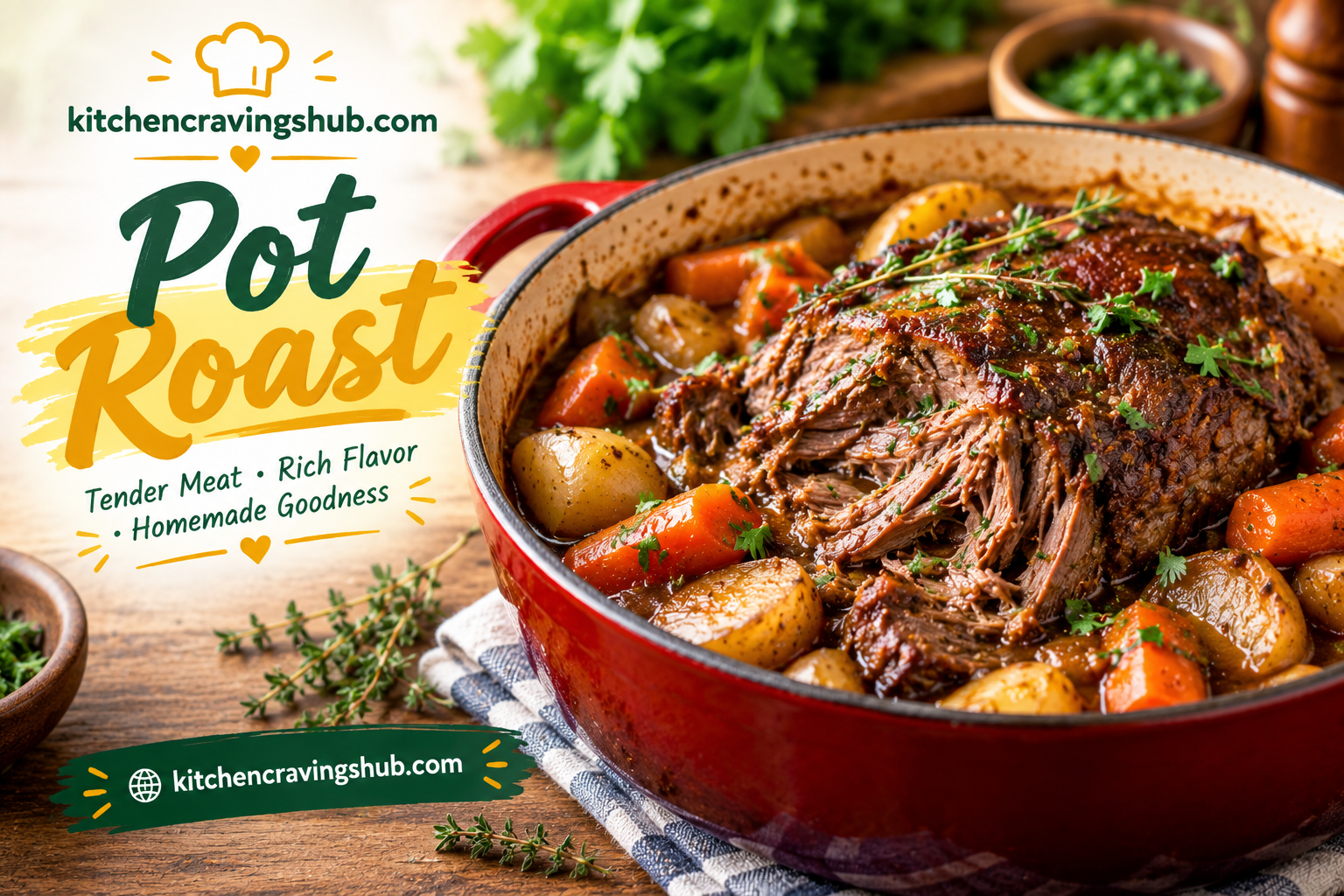
There is a reason pot roast has earned its place as the quintessential Sunday dinner. It fills the house with the kind of aroma that pulls everyone toward the kitchen hours before dinner is even ready. It is the dish that turns a tough, inexpensive cut of beef into something fall apart tender, rich, and deeply comforting. And best of all, it largely cooks itself, leaving you free to enjoy your day while dinner quietly transforms in the oven or slow cooker.
This guide walks through everything you need to make a truly great pot roast, from choosing the right cut of beef to building layers of flavor with vegetables and broth. Whether you are making this for the first time or looking to improve a recipe you already love, you will find everything you need right here.
Why Pot Roast Is the Ultimate Comfort Meal 🏡
Pot roast belongs to a category of cooking sometimes called low and slow, and that method is exactly what makes it so special. Tough cuts of beef that would be chewy if grilled or seared quickly instead become tender and rich when cooked gently over several hours.
Beyond the technique, pot roast also delivers an entire meal in one pot, with tender meat, soft vegetables, and a flavorful gravy all developing together as it cooks.
| Reason It Works 🌟 | Why It Matters |
|---|---|
| Transforms tough cuts | Low, slow cooking breaks down connective tissue |
| One pot meal | Meat, vegetables, and gravy cook together |
| Budget friendly | Uses inexpensive cuts of beef |
| Hands off cooking | Mostly unattended once it is in the oven or slow cooker |
| Great for leftovers | Flavor often improves the next day |
Choosing the Right Cut of Beef 🥩
Not every cut of beef is suited for pot roast. The best choices come from well worked muscles containing plenty of connective tissue, which slowly melts into gelatin during long cooking, creating that signature tender texture.
Best Cuts for Pot Roast 🐄
- 🥩 Chuck roast, widely considered the gold standard for pot roast
- 🥩 Brisket, rich and flavorful with a slightly different texture
- 🥩 Bottom round roast, leaner but still works well with proper cooking time
- 🥩 Short ribs, offering extra richness for a more indulgent version
| Cut of Beef 🥩 | Characteristics |
|---|---|
| Chuck roast | Well marbled, classic choice, very tender when slow cooked |
| Brisket | Rich flavor, slightly firmer texture |
| Bottom round | Leaner, still tender with proper technique |
| Short ribs | Extra rich and flavorful, great for special occasions |
Chuck roast remains the most popular choice for good reason. Its generous marbling and connective tissue break down beautifully over several hours, resulting in that classic fall apart texture pot roast is known for.
The Science Behind Low and Slow Cooking 🔬
Understanding why low and slow cooking works helps explain why rushing a pot roast never ends well. Tough cuts of beef contain collagen, a connective tissue that is chewy and firm at lower temperatures but transforms into soft, silky gelatin when cooked slowly at the right temperature over time.
This is also why pot roast actually benefits from cuts that would be considered too tough for quick cooking methods like grilling. The very toughness that makes a cut unsuitable for a quick sear is exactly what makes it perfect for a long, slow braise.
| Cooking Stage 🔥 | What Happens |
|---|---|
| Searing | Develops deep, browned flavor on the surface |
| Early braising | Collagen begins breaking down slowly |
| Extended braising | Collagen fully converts into tender gelatin |
| Resting | Juices redistribute throughout the meat |
Searing: The Step You Should Never Skip 🔥
Before any liquid goes into the pot, searing the roast on all sides in a hot pan with a bit of oil builds a deep, caramelized crust that adds tremendous flavor to the final dish. This step, often called the Maillard reaction, creates complex savory notes that a roast simply will not develop if you skip straight to braising.
Searing Tips 🍳
- 🔥 Pat the roast completely dry before searing for the best browning
- 🧈 Use a heavy pot like a Dutch oven that retains heat well
- ⏱️ Sear for 3 to 4 minutes per side until deeply browned
- 🚫 Avoid moving the roast too early, which prevents proper crust formation
Building the Braising Liquid 🍷
The liquid your pot roast cooks in becomes the base for its gravy, so building layers of flavor here matters enormously.
Classic Braising Liquid Ingredients 🥘
- 🍷 Red wine or beef broth, forming the flavorful base
- 🧅 Onions, garlic, and celery, building aromatic depth
- 🍅 Tomato paste, adding richness and slight acidity
- 🌿 Bay leaves and fresh thyme, contributing herbal complexity
- 🧂 Worcestershire sauce, adding savory umami depth
| Braising Liquid Component 🍲 | Function |
|---|---|
| Beef broth or wine | Forms the flavorful cooking liquid |
| Aromatics | Builds foundational savory flavor |
| Tomato paste | Adds richness and depth |
| Herbs | Provides fresh, earthy complexity |
| Worcestershire sauce | Deepens umami flavor |
A helpful technique is deglazing the pot with wine or broth right after searing, scraping up the browned bits stuck to the bottom. Those browned bits, sometimes called fond, are packed with flavor that would otherwise go to waste.
Choosing the Right Vegetables 🥕
Classic pot roast vegetables are chosen for their ability to hold up during hours of slow cooking without turning to mush.
Best Vegetables for Pot Roast 🥔
- 🥔 Potatoes, particularly waxy varieties that hold their shape
- 🥕 Carrots, adding natural sweetness as they cook down
- 🧅 Pearl onions or quartered yellow onions
- 🌾 Celery, adding subtle aromatic depth
- 🍄 Mushrooms, contributing earthy richness
| Vegetable 🥕 | Timing Tip |
|---|---|
| Potatoes | Add partway through for best texture |
| Carrots | Can go in early, holds up well |
| Onions | Add at the start for maximum flavor infusion |
| Celery | Add early alongside onions |
| Mushrooms | Best added in the final hour |
Potatoes in particular benefit from being added partway through the cooking process rather than at the very beginning, since they can turn overly soft if they cook for the entire braising time.
Cooking Methods for Pot Roast 🍲
Pot roast can be made using several different methods, each offering slightly different convenience and results.
Oven Braising 🔥
The traditional method involves searing the roast, adding braising liquid and vegetables, covering tightly, and cooking low and slow in the oven, typically around 300°F (150°C) for several hours.
Slow Cooker Method 🍲
A slow cooker offers a convenient, hands off approach, perfect for busy days when you want dinner ready without checking on it throughout the day.
Instant Pot or Pressure Cooker 🔥
For a faster option, a pressure cooker can achieve tender results in a fraction of the time, though many cooks feel the flavor and texture from traditional slow braising is worth the extra wait.
| Cooking Method 🍲 | Approximate Time | Best For |
|---|---|---|
| Oven braising | 3 to 4 hours | Rich, deeply developed flavor |
| Slow cooker | 8 to 10 hours on low | Convenient, hands off cooking |
| Pressure cooker | 60 to 90 minutes | Faster results when short on time |
Pot Roast Temperature and Doneness Guide 🌡️
Unlike a steak, pot roast is not judged by traditional doneness levels like medium or well done. Instead, you are looking for the internal temperature where collagen has fully broken down into tender gelatin.
| Doneness Goal 🌡️ | Internal Temperature |
|---|---|
| Minimum safe temperature | 145°F (63°C) |
| Tender, fall apart texture | 200°F to 205°F (93°C to 96°C) |
This is one of the rare cases in cooking where you actually want to cook well past the minimum safe temperature. Pot roast needs that extended time at higher internal temperatures for the connective tissue to properly break down.
Making a Rich Gravy From the Braising Liquid 🥄
Once your pot roast is finished, the braising liquid left behind is liquid gold. Turning it into a rich gravy is a simple final step that elevates the entire meal.
Steps to Build the Gravy 📋
- 🍲 Remove the roast and vegetables, straining the liquid if desired
- 🔥 Simmer the liquid on the stovetop to reduce and concentrate flavor
- 🧈 Whisk in a flour or cornstarch slurry to thicken
- 🧂 Taste and adjust seasoning with salt, pepper, and a splash of Worcestershire sauce
| Gravy Thickener 🥄 | Method |
|---|---|
| Flour slurry | Whisk flour with cold water, add gradually while simmering |
| Cornstarch slurry | Similar method, creates a glossier finish |
| Reduction only | Simmer longer without thickener for a lighter gravy |
Best Side Dishes to Serve With Pot Roast 🍽️
While pot roast often comes with its own vegetables built in, a few additional sides round out the meal beautifully.
| Side Dish 🍽️ | Why It Works |
|---|---|
| Mashed potatoes | Perfect for soaking up extra gravy |
| Crusty bread | Great for mopping up the braising liquid |
| Roasted Brussels sprouts | Adds freshness and slight bitterness to balance richness |
| Buttered egg noodles | A comforting, hearty pairing |
| Simple green salad | Provides a lighter, fresh contrast |
Storing and Reheating Pot Roast ❄️
Pot roast is famously even better the next day, making it an excellent make ahead meal.
Storage Tips 🧊
- 🧊 Store cooled pot roast with its liquid in an airtight container
- 📅 Use within 3 to 4 days for best quality
- ❄️ Freeze in portions for up to 3 months
Reheating Tips 🔥
- 🔥 Reheat gently on the stovetop with a bit of extra broth to maintain moisture
- 🍲 Oven reheating at 300°F (150°C) covered with foil also works well
- 🚫 Avoid high heat reheating, which can toughen the tender meat
| Storage Method 🧊 | Duration |
|---|---|
| Refrigerator | 3 to 4 days |
| Freezer | Up to 3 months |
| Best reheating method | Stovetop or oven, gentle heat with added liquid |
Common Mistakes That Ruin Pot Roast ⚠️
Even a forgiving dish like pot roast has a few pitfalls worth avoiding.
- Skipping the sear, missing out on essential deep flavor
- Cooking at too high a temperature, toughening the meat instead of tenderizing it
- Removing the roast too early, before collagen has fully broken down
- Adding potatoes too early, resulting in mushy, overcooked texture
- Not deglazing the pot, wasting flavorful browned bits
- Slicing against too thin or too thick, affecting texture in the final dish
Frequently Asked Questions ❓
Why is my pot roast tough even after hours of cooking? This usually means it needs more time. Pot roast becomes tender well past the point of being safely cooked, often requiring an internal temperature closer to 200°F for the collagen to fully break down.
Can I make pot roast without searing first? You can, but searing adds significant flavor through browning, so it is highly recommended even though it adds a few extra minutes to the process.
What is the best cut of beef for pot roast? Chuck roast is the most popular and reliable choice thanks to its generous marbling and connective tissue that breaks down beautifully during slow cooking.
Can I make pot roast in a slow cooker instead of the oven? Yes, a slow cooker works wonderfully for pot roast, typically requiring 8 to 10 hours on low heat for tender, flavorful results.
Final Thoughts on Making the Perfect Pot Roast 🌟
A truly great pot roast is really about patience more than skill. Choosing the right cut, taking the time to sear properly, building a flavorful braising liquid, and allowing plenty of low, slow cooking time are what transform a humble piece of beef into a deeply comforting, memorable meal.
Set aside a lazy afternoon, let your kitchen fill with that irresistible aroma, and enjoy the simple reward of a pot roast done right. Few meals bring people to the table quite like it.
Happy cooking! 🍲