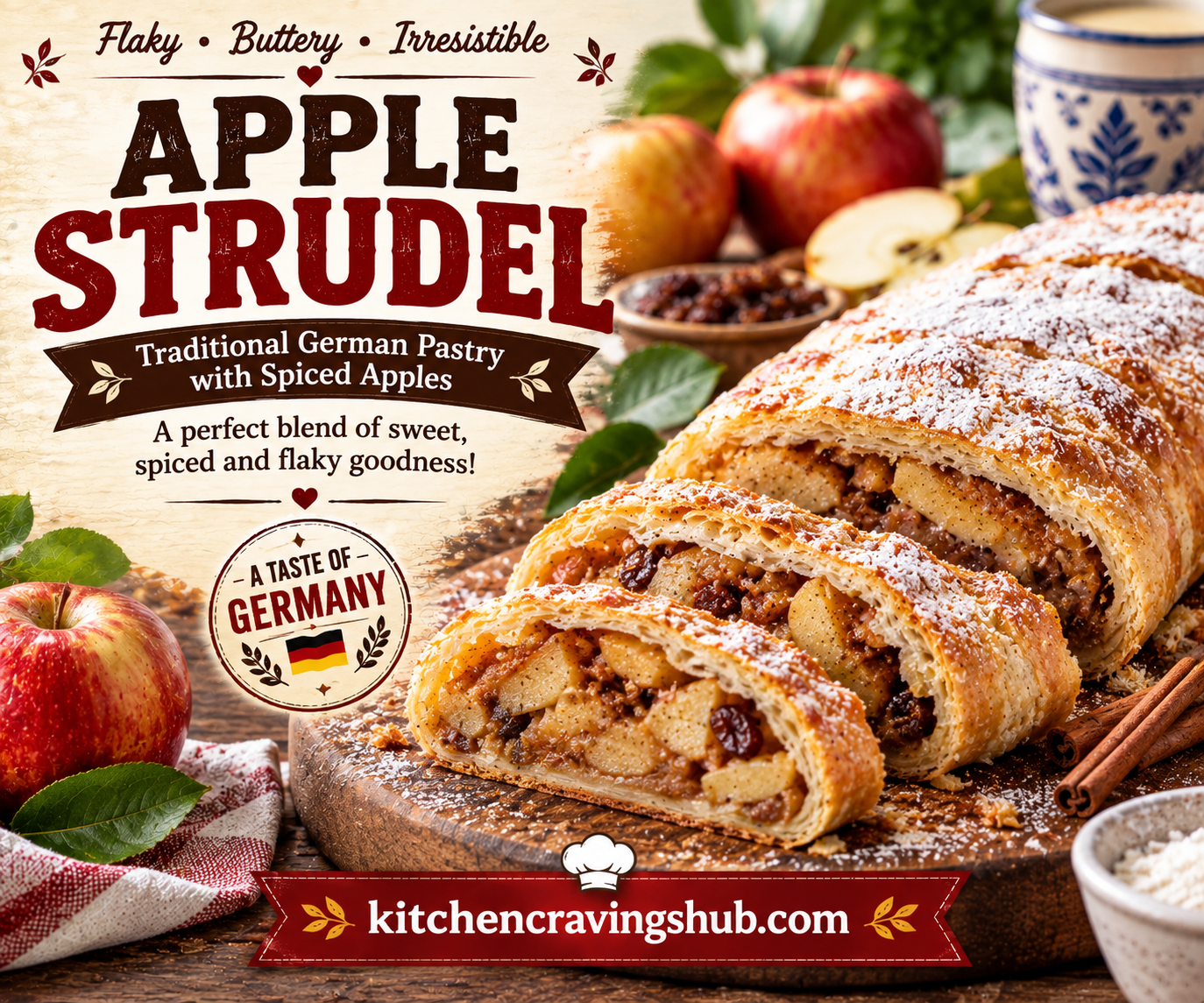
Few desserts feel as elegant yet homey as apple strudel. Layers of impossibly thin, flaky pastry wrapped around a warm, spiced apple filling, dusted with powdered sugar and often served with a scoop of vanilla ice cream or a dollop of whipped cream. It’s a dessert with centuries of history behind it, beloved across Central Europe and adored around the world today. This guide covers everything from its fascinating origins to a full step by step recipe, plus tips, variations, and answers to common questions.
📜 A Brief History of Apple Strudel
Apple strudel, known as “Apfelstrudel” in German, is most closely associated with Austria, particularly Vienna, but its roots trace back much further and further east than most people realize. The technique of stretching dough paper thin actually traveled to Europe from the Ottoman Empire and Middle Eastern baklava traditions, arriving in the Austro Hungarian Empire sometime around the 17th century.
Once the technique reached Vienna, local bakers adapted it, swapping nuts and honey for apples, cinnamon, and raisins, ingredients that were more readily available in Central Europe. By the 18th and 19th centuries, apple strudel had become a beloved staple of Viennese coffeehouse culture, served alongside coffee as an afternoon treat, and it remains one of Austria’s most iconic culinary exports today.
| Region | Local Name | Notable Twist |
|---|---|---|
| Austria | Apfelstrudel | The classic version, thin pastry, spiced apples, raisins |
| Germany | Apfelstrudel | Very similar, sometimes with added marzipan |
| Hungary | Almás Rétes | Uses a similar stretched dough called rétestészta |
| Czech Republic | Jablkový Závin | Comparable filling, often includes breadcrumbs to absorb moisture |
| Italy, South Tyrol region | Strudel di Mele | Reflects the Austrian influence in this bilingual region |
🥐 What Makes Strudel Dough Different
The defining feature of true apple strudel is the pastry itself. Unlike puff pastry, which relies on many layers of butter to create flakiness through baking, strudel dough is a simple, elastic dough made from flour, water, a touch of oil, and sometimes egg or vinegar, that is then stretched by hand until it becomes almost translucent.
Traditional bakers famously stretch the dough over a large table until it’s thin enough to read a newspaper through it. This paper thin quality is what creates strudel’s signature delicate, crackly layers once baked, quite different from the rich, buttery layers of puff pastry.
That said, many home cooks today use store bought phyllo dough as a convenient substitute, since achieving the traditional hand stretched dough takes considerable practice and a bit of a knack.
| Dough Type | Texture | Difficulty Level |
|---|---|---|
| 🧵 Traditional hand stretched strudel dough | Paper thin, delicate, slightly chewy | Advanced, requires practice |
| 🥞 Phyllo dough | Thin, crisp, flaky layers | Beginner friendly, widely available |
| 🧈 Puff pastry | Rich, buttery, more substantial layers | Easiest, though less traditional |
🍎 Choosing the Right Apples
The apple filling is the heart of the dish, and choosing the right variety makes a real difference in flavor and texture once baked.
| Apple Variety | Flavor Profile | Why It Works |
|---|---|---|
| 🍏 Granny Smith | Tart, firm | Holds its shape well, balances the sweetness of sugar |
| 🍎 Honeycrisp | Sweet, crisp | Adds natural sweetness and juiciness |
| 🍏 Braeburn | Slightly tart, firm | Great texture that doesn’t turn mushy |
| 🍎 Jonagold | Sweet with a hint of tartness | A classic European choice for strudel |
| 🍏 Gala | Mild, sweet | Softens nicely but still holds some structure |
Many bakers like to combine a tart variety like Granny Smith with a sweeter variety like Honeycrisp or Gala, striking a pleasant balance between tanginess and sweetness in the finished strudel.
🌱 Nutritional Overview
While apple strudel is certainly a treat rather than a health food, it does offer a few genuine nutritional upsides thanks to its fruit forward filling.
| Nutrient (per typical slice) | Approximate Amount | Note |
|---|---|---|
| 🍎 Fiber | 2 to 3 grams | Comes primarily from the apples |
| 🍬 Sugar | Moderate to high | Varies based on added sugar in the filling |
| 🧈 Fat | Moderate | Largely from butter brushed between pastry layers |
| ⚡ Calories | Roughly 250 to 350 per slice | Varies based on portion size and recipe |
| 🌿 Vitamin C | Small amount | Retained from the apples despite baking |
As with most desserts, moderation is the name of the game, but the apple filling does mean you’re getting a bit of fiber and vitamins alongside the indulgence.
🛒 Core Ingredients
Here’s what goes into a classic apple strudel filling and assembly.
| Ingredient | Role in the Recipe |
|---|---|
| 🍎 Apples | The star of the filling, provides bulk and flavor |
| 🍬 Sugar | Sweetens the filling |
| 🌰 Cinnamon | Classic warming spice that pairs perfectly with apples |
| 🍇 Raisins | Adds chewy sweetness throughout the filling |
| 🍞 Breadcrumbs | Absorbs excess moisture so the pastry doesn’t turn soggy |
| 🧈 Butter | Brushed between pastry layers for richness and flakiness |
| 🥐 Phyllo dough or strudel dough | The pastry that wraps around the filling |
| 🍋 Lemon juice | Brightens the filling and prevents apples from browning |
| 🌰 Chopped walnuts | Optional, adds crunch and nutty flavor |
| 🍚 Powdered sugar | For dusting the finished strudel |
👩🍳 How to Make Apple Strudel: Step by Step
Here is a reliable recipe using phyllo dough, a great option for home bakers, that yields about 8 servings.
🧾 Ingredient List
| Ingredient | Amount |
|---|---|
| Apples, peeled and thinly sliced | 6 medium |
| Granulated sugar | 1/2 cup |
| Ground cinnamon | 1 teaspoon |
| Raisins | 1/2 cup |
| Chopped walnuts | 1/3 cup, optional |
| Lemon juice | 1 tablespoon |
| Plain breadcrumbs | 1/2 cup |
| Unsalted butter, melted | 3/4 cup |
| Phyllo dough sheets | 10 sheets, thawed |
| Powdered sugar | For dusting |
🔥 Step by Step Instructions
- 🍎 In a large bowl, toss the sliced apples with sugar, cinnamon, raisins, walnuts if using, and lemon juice. Let the mixture sit for about 10 minutes so the flavors meld.
- 🍳 In a small pan, lightly toast the breadcrumbs in a tablespoon of the melted butter until golden, about 3 to 4 minutes. Set aside.
- 🧈 Preheat your oven to 375°F, or 190°C. Line a baking sheet with parchment paper.
- 🥐 Lay a clean kitchen towel on your work surface and place one sheet of phyllo dough on top. Brush lightly with melted butter, then layer another sheet on top and repeat, brushing each layer, until you’ve stacked all 10 sheets.
- 🍞 Sprinkle the toasted breadcrumbs evenly over the phyllo stack, leaving a two inch border around the edges. This layer helps absorb moisture from the apples during baking.
- 🍎 Spoon the apple mixture in a line along one long edge of the phyllo stack, about two inches from the edge.
- 🌀 Using the towel to help guide it, gently roll the phyllo up and over the filling, tucking in the sides as you go, forming a tight log.
- 🥐 Carefully transfer the strudel, seam side down, onto the prepared baking sheet. Brush the top generously with the remaining melted butter.
- 🔥 Bake for 35 to 40 minutes, until the pastry is golden brown and crisp.
- ❄️ Let the strudel cool for about 15 minutes before slicing, then dust generously with powdered sugar just before serving.
⏲️ Baking Time and Temperature Guide
| Dough Type | Oven Temperature | Baking Time |
|---|---|---|
| 🥞 Phyllo dough | 375°F or 190°C | 35 to 40 minutes |
| 🧵 Traditional hand stretched dough | 400°F or 200°C | 30 to 35 minutes |
| 🧈 Puff pastry | 400°F or 200°C | 25 to 30 minutes |
🥄 Tips for Getting It Just Right
- 🍞 Never skip the breadcrumb layer. It absorbs excess apple juice as the strudel bakes, keeping the bottom pastry crisp rather than soggy.
- 🌡️ Let apples release a bit of their juice before assembling by letting the sugared mixture sit for a few minutes, then drain any excess liquid if it seems very wet.
- 🧈 Brush every layer of phyllo generously with butter. Skimping leads to dry, less flaky results.
- 🥐 Work quickly with phyllo dough, since it dries out fast when exposed to air. Keep unused sheets covered with a damp towel while you work.
- ❄️ Allow the strudel to cool slightly before slicing so the filling has time to set and won’t spill out messily.
- 🔪 Use a serrated knife for the cleanest slices through the delicate, flaky layers.
🌍 Variations Worth Trying
Once you’ve mastered the classic version, there are plenty of delicious directions to take apple strudel.
| Variation | Distinct Features |
|---|---|
| 🧀 Cream Cheese Apple Strudel | Adds a layer of sweetened cream cheese beneath the apple filling |
| 🌰 Nut Free Version | Skips walnuts entirely, relies purely on apples, raisins, and spice |
| 🍑 Mixed Fruit Strudel | Combines apples with pears, apricots, or cherries |
| 🍫 Chocolate Apple Strudel | Adds a sprinkle of chocolate chips or shavings into the filling |
| 🥃 Rum Soaked Raisin Strudel | Soaks raisins in rum before adding them to the filling for extra depth |
| 🌱 Vegan Apple Strudel | Uses plant based butter and skips egg wash, relying on oil brushing instead |
🍨 What to Serve with Apple Strudel
Apple strudel is wonderful on its own, but a few classic accompaniments elevate it even further.
- 🍦 A scoop of vanilla ice cream, melting slightly against the warm pastry
- 🥛 Warm vanilla custard sauce, a traditional Austrian pairing
- 🍯 A light drizzle of honey or caramel sauce
- ☕ A strong cup of coffee or a pot of tea, echoing its Viennese coffeehouse origins
- 🍨 Lightly sweetened whipped cream for a simpler finish
🧊 Storing and Reheating
| Storage Method | How Long It Lasts | Tips |
|---|---|---|
| 🧊 Refrigerator | 3 to 4 days | Store in an airtight container, pastry will soften slightly |
| ❄️ Freezer, baked | Up to 2 months | Wrap tightly, thaw before reheating |
| ❄️ Freezer, unbaked | Up to 1 month | Assemble fully, freeze, then bake straight from frozen, adding extra time |
| 🔥 Reheating in oven | 10 to 15 minutes at 350°F | Best method to restore crispness |
| 📡 Reheating in microwave | Not recommended | Makes pastry soggy rather than crisp |
❓ Frequently Asked Questions
Can I make apple strudel ahead of time? Yes. You can assemble the strudel completely, then refrigerate it unbaked for a few hours, or freeze it unbaked for up to a month. Bake straight from cold or frozen, adding a few extra minutes to the bake time.
Why did my strudel turn soggy on the bottom? This usually happens when there’s too much moisture in the apple filling, or when the breadcrumb layer is skipped. Toasting breadcrumbs and letting the apple mixture drain briefly before assembling helps prevent this.
Can I use store bought puff pastry instead of phyllo? Yes, though the texture will be noticeably different, richer and more substantial rather than delicately crisp and flaky. It’s a great shortcut if phyllo isn’t available.
Is apple strudel the same as apple pie? Not quite. While both feature spiced apple filling, strudel uses thin, flaky pastry layers rolled around the filling, while pie relies on a thicker, more substantial crust baked in a dish.
🌟 Final Thoughts
Apple strudel is a beautiful example of how a technique can travel across empires and centuries, transforming along the way into something entirely its own. What began as a Middle Eastern pastry tradition became, through the hands of Viennese bakers, one of Central Europe’s most treasured desserts. Whether you attempt the traditional hand stretched dough or take the more approachable phyllo route, the result, warm spiced apples wrapped in delicate, golden layers, is always worth the effort.
Serve it warm with a scoop of ice cream, a dusting of powdered sugar, and maybe a strong cup of coffee, and you’ll understand exactly why this dessert has charmed people for hundreds of years. 🍎🥐✨