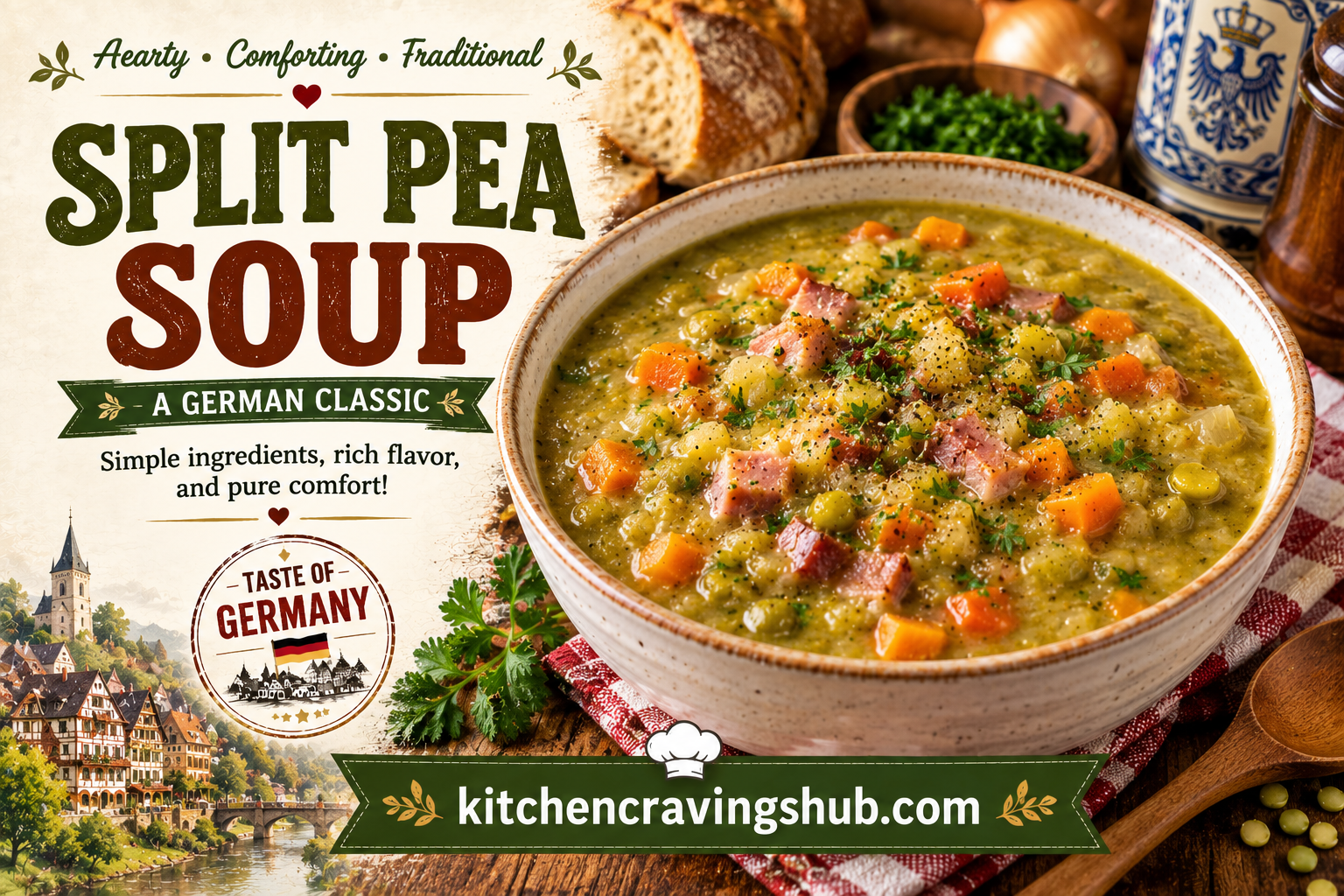
Few dishes capture the feeling of a cozy kitchen quite like a simmering pot of split pea soup. Thick, hearty, and deeply savory, it’s the kind of meal that turns humble pantry ingredients into something comforting and satisfying. Whether you grew up eating it from a can or have never tried it at all, this guide covers everything you need to know: its history, nutritional value, how to make it from scratch, variations from around the world, and tips for getting that perfect creamy texture every time.
📜 A Brief History of Split Pea Soup
Split pea soup has ancient roots. Dried peas have been cultivated for thousands of years, and evidence suggests pea based soups and porridges were eaten as far back as the Stone Age. Ancient Greeks and Romans sold pea soup from street stalls, and the dish traveled through medieval Europe as a staple for peasants and nobility alike, since dried peas stored well through winter months when fresh vegetables were scarce.
In more recent history, split pea soup became especially popular in the Netherlands, where it’s known as “erwtensoep” or “snert,” a thick winter soup traditionally loaded with smoked sausage and served so dense that a spoon can practically stand up in it. It also became a comfort food staple in the United States and Canada, often made with a leftover ham bone after a holiday meal.
| Region | Local Name | Notable Twist |
|---|---|---|
| Netherlands | Erwtensoep or Snert | Extremely thick, served with rye bread and mustard |
| United States | Split Pea Soup | Often made with ham bone or bacon |
| Germany | Erbsensuppe | Frequently includes sausage like Kielbasa |
| United Kingdom | Pease Pudding adjacent dishes | Historically boiled in a cloth bag |
| Scandinavia | Ärtsoppa | Traditionally eaten on Thursdays, paired with pancakes |
🥣 What Exactly Is Split Pea Soup?
Split peas are simply dried peas that have had their outer skins removed and been split along a natural seam. This processing means they cook faster than whole dried peas and break down into a naturally thick, creamy consistency without needing any added cream or thickener. They come in two common varieties, green and yellow, both of which work beautifully in soup.
🟢 Green split peas tend to have a slightly more robust, earthy flavor. 🟡 Yellow split peas are a touch milder and sweeter, often used in Indian dal and Scandinavian style soups.
🌱 Nutritional Benefits
Split pea soup isn’t just comforting, it’s genuinely good for you. Split peas are a nutritional powerhouse packed into a small, humble legume.
| Nutrient (per 1 cup cooked split peas) | Approximate Amount | Why It Matters |
|---|---|---|
| 💪 Protein | About 16 grams | Supports muscle repair and satiety |
| 🌾 Fiber | About 16 grams | Aids digestion and helps regulate blood sugar |
| 🔋 Iron | About 2.5 milligrams | Supports energy and oxygen transport |
| 🧠 Folate | High levels | Important for cell growth and function |
| ⚡ Potassium | Significant amount | Supports healthy blood pressure |
| 🥑 Fat | Very low, especially without added meat | Naturally heart friendly |
Because split peas are high in both protein and fiber, split pea soup is naturally filling, which makes it a popular choice for anyone looking for a satisfying, budget friendly, plant forward meal.
🛒 Core Ingredients
At its heart, split pea soup is built from a short list of humble ingredients. Here’s what a classic version typically includes.
| Ingredient | Role in the Soup |
|---|---|
| 🫛 Dried split peas | The star ingredient, provides body and protein |
| 🧅 Onion | Builds savory aromatic base |
| 🥕 Carrots | Adds sweetness and color |
| 🌿 Celery | Rounds out the classic aromatic trio |
| 🧄 Garlic | Deepens flavor |
| 🥓 Ham bone, ham hock, or bacon | Adds smoky, savory depth, optional for vegetarian versions |
| 🍃 Bay leaf and thyme | Classic herbs that complement the earthiness of peas |
| 🧂 Salt and pepper | Essential seasoning |
| 💧 Broth or water | The cooking liquid that becomes the soup base |
👩🍳 How to Make Split Pea Soup: Step by Step
Here is a straightforward, reliable method for a pot of classic split pea soup that serves about six people.
🧾 Ingredient List
| Ingredient | Amount |
|---|---|
| Dried green split peas | 2 cups, rinsed |
| Ham bone or smoked ham hock | 1, or 1.5 cups diced cooked ham |
| Onion, diced | 1 medium |
| Carrots, diced | 2 medium |
| Celery stalks, diced | 2 |
| Garlic, minced | 3 cloves |
| Chicken or vegetable broth | 6 cups |
| Bay leaves | 2 |
| Dried thyme | 1 teaspoon |
| Olive oil or butter | 2 tablespoons |
| Salt and black pepper | To taste |
🔥 Step by Step Instructions
- 🍳 Warm the olive oil or butter in a large pot over medium heat. Add the onion, carrots, and celery, and cook until softened, about 6 to 8 minutes.
- 🧄 Stir in the garlic and cook for another minute until fragrant.
- 🫛 Add the rinsed split peas, ham bone or ham hock, broth, bay leaves, and thyme.
- 🔥 Bring the pot to a boil, then reduce heat to low, cover partially, and let it simmer gently.
- ⏲️ Simmer for about 60 to 75 minutes, stirring occasionally, until the peas have fully broken down into a thick, creamy consistency.
- 🍖 Remove the ham bone, shred any meat from it, and stir the meat back into the soup. Discard the bone and bay leaves.
- 🧂 Season generously with salt and pepper to taste.
- 🥣 Ladle into bowls and serve warm, with crusty bread on the side.
⏲️ Cooking Time Comparison
| Method | Approximate Time | Notes |
|---|---|---|
| 🍲 Stovetop | 60 to 75 minutes simmering | Most traditional method, easy to monitor |
| 🐢 Slow Cooker | 6 to 8 hours on low, or 3 to 4 hours on high | Great for hands off cooking |
| ⚡ Instant Pot or Pressure Cooker | 15 to 20 minutes high pressure, plus natural release | Fastest option, no need to presoak peas |
🥄 Getting the Perfect Texture
One of the joys of split pea soup is its naturally thick, velvety texture, but getting it just right takes a little attention.
- 💧 If the soup seems too thin after simmering, let it cook uncovered a bit longer to reduce and thicken naturally.
- 🥣 If it’s too thick, simply stir in a splash more broth or water until it reaches your preferred consistency.
- 🌀 For an extra smooth, restaurant style finish, blend a portion of the soup with an immersion blender and stir it back in, leaving some texture intact.
- 🧊 Keep in mind the soup will continue to thicken as it cools and again once refrigerated, so it may need thinning when reheated.
🌍 Variations from Around the World
Split pea soup takes many delicious forms depending on where you are in the world.
| Variation | Distinct Features |
|---|---|
| 🇳🇱 Dutch Erwtensoep | Extremely thick, loaded with smoked sausage, served with rye bread and mustard |
| 🇮🇳 Indian Dal | Made with yellow split peas, seasoned with cumin, turmeric, and chili, often finished with a tempered spice topping |
| 🇸🇪 Swedish Ärtsoppa | Lightly seasoned, traditionally paired with mustard and served with pancakes for dessert |
| 🌱 Vegan Split Pea Soup | Skips meat entirely, relies on smoked paprika or liquid smoke for depth |
| 🌶️ Spicy Split Pea Soup | Adds chili flakes, cumin, or curry powder for a warming kick |
| 🥓 American Ham and Bacon Style | Rich, smoky, often the classic post holiday leftover recipe |
🌱 Making It Vegetarian or Vegan
Split pea soup is naturally easy to adapt for plant based diets since the peas themselves provide plenty of protein and body without any meat at all.
- 🚫🥓 Skip the ham bone or bacon entirely
- 🍄 Add a tablespoon of smoked paprika or a few drops of liquid smoke to mimic that smoky depth
- 🧈 Use vegetable broth instead of chicken broth
- 🥔 Add diced potato for extra heartiness
- 🍄 Sauteed mushrooms can add a savory, umami boost that mimics some of what meat would normally contribute
🧊 Storing and Reheating
Split pea soup is famously good the next day, since the flavors continue to meld overnight.
| Storage Method | How Long It Lasts | Tips |
|---|---|---|
| 🧊 Refrigerator | 4 to 5 days | Store in an airtight container |
| ❄️ Freezer | Up to 3 months | Freezes well due to low fat content |
| 🔥 Reheating on stovetop | 5 to 10 minutes | Add a splash of broth or water to loosen texture |
| 📡 Reheating in microwave | 2 to 3 minutes, stirring halfway | Cover to avoid splattering |
🍞 What to Serve with Split Pea Soup
A bowl of split pea soup pairs beautifully with simple sides that balance its rich, earthy flavor.
- 🥖 Crusty bread or a warm baguette for dipping
- 🧀 A sharp cheddar or gruyere grilled cheese sandwich
- 🥗 A crisp green salad with a tangy vinaigrette to cut through the richness
- 🥧 Cornbread for a slightly sweet contrast
- 🍷 A light, crisp white wine if you enjoy pairing wine with soup
❓ Frequently Asked Questions
Do I need to soak split peas before cooking? Unlike many dried beans, split peas generally don’t require presoaking. Their small size and split form allow them to cook through in about an hour without any advance preparation, though a quick soak can shave a little time off the process if you prefer.
Why didn’t my split peas fully break down? Older dried peas that have sat in storage for a long time can take longer to soften, or may not break down as completely. Simmering longer, or adding a pinch of baking soda to soften them faster, can help.
Can I make split pea soup without any meat flavoring at all? Absolutely. A well seasoned vegetable broth, plenty of aromatics, and a touch of smoked paprika can create a deeply flavorful soup without any meat products.
Is split pea soup good for weight management? Thanks to its high fiber and protein content, split pea soup tends to be very filling relative to its calorie count, making it a popular choice for those watching their intake while still wanting a satisfying meal.
🌟 Final Thoughts
Split pea soup proves that some of the most comforting meals come from the simplest ingredients. A humble bag of dried peas, a few aromatic vegetables, and a bit of patience at the stove transform into a rich, creamy, deeply satisfying bowl of soup that has nourished people across cultures for centuries. Whether you make it the classic way with a smoky ham bone, go fully plant based, or add a spicy twist inspired by Indian dal, this soup is endlessly adaptable and always rewarding.
Once you make a batch, you’ll likely understand why this dish, humble as it may seem, has remained a beloved staple in kitchens around the world for generations. 🍲✨🥄